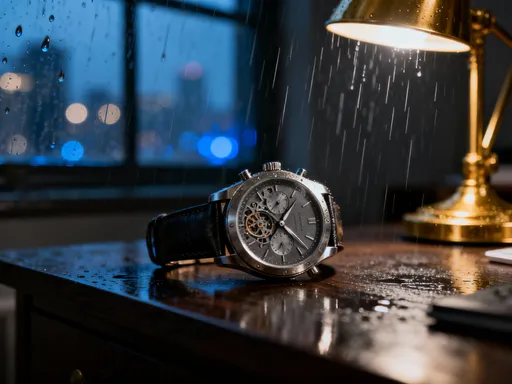
Why Luxury Watches Aren’t Just Timepieces — My Expert Reality Check on Hidden Investment Risks
You’ve seen the headlines — luxury watches selling for millions, prices climbing year after year. It’s easy to think: Why not invest? I did. But behind the polished dials and prestige lies a risky, opaque market few truly understand. As someone who’s navigated this world from the inside, I’ve seen collectors win big — and lose even bigger. This isn’t Wall Street; it’s part art, part gamble. Let me walk you through what most experts won’t tell you. The truth is, while a rare Rolex or Patek Philippe can fetch astonishing sums at auction, the average buyer is far more likely to break even — or lose money — than to strike gold. The emotional pull is strong, but the financial logic is fragile. This is not a path to guaranteed wealth, and treating it as such can lead to painful lessons.
The Allure of Luxury Watch Investment: What Draws People In
Luxury watches have transcended their original function as timekeeping devices to become symbols of success, craftsmanship, and legacy. For many, owning a Rolex, Audemars Piguet, or Jaeger LeCoultre is not just about telling time — it’s about making a statement. The appeal is deeply psychological, rooted in the desire for permanence in an age of disposability. These timepieces are built to last, often passed down through generations, and their mechanical complexity inspires awe. Unlike digital gadgets that become obsolete in months, a well-maintained watch from the 1950s can still keep near-perfect time today. This durability, combined with the prestige of Swiss engineering and hand-finishing, fuels the perception that luxury watches are not just accessories, but assets.
What amplifies this belief is the visibility of extreme success stories. A 1968 Rolex Daytona once sold for over $17 million at auction. Patek Philippe models regularly fetch seven figures. These headlines dominate social media, where influencers and collectors showcase their latest acquisitions, often framing them as savvy investments. Celebrity ownership — from Paul Newman’s iconic Daytona to modern stars wearing limited editions — adds another layer of desirability. The narrative becomes self-reinforcing: scarcity drives demand, demand pushes prices up, and rising prices attract more buyers. This cycle creates a sense that luxury watches are immune to depreciation, a notion that is both seductive and dangerously misleading.
Yet, it’s crucial to distinguish between cultural value and financial return. While a watch may carry immense emotional or symbolic worth, that does not guarantee it will appreciate in monetary terms. The market is highly selective, favoring only a narrow subset of brands, models, and conditions. For every Rolex Submariner that doubles in value, there are dozens of similar models that remain stagnant. The truth is that most luxury watches are not designed to be investments. They are made for wearing, for enjoyment, for personal significance. When investors treat them purely as financial instruments, they risk misunderstanding the very nature of what they own. The allure is real, but it must be tempered with realism.
The Illusion of Guaranteed Returns: Why Past Performance Isn’t a Promise
The idea that luxury watches consistently increase in value is one of the most persistent myths in alternative investing. While it’s true that certain vintage models have delivered extraordinary returns, these cases are the exception, not the rule. The broader market tells a different story. A 2022 report by Knight Frank’s Luxury Investment Index showed that while the top 10% of watches appreciated by over 15% annually, the median return across all models was barely above inflation. This gap reveals a critical truth: performance is not uniform. Only a handful of references — such as the Rolex Daytona ‘Paul Newman’, the Audemars Piguet Royal Oak ‘Jumbo’, or the Patek Philippe 5711 — have demonstrated sustained appreciation. The vast majority of luxury watches, even from prestigious brands, do not follow this trajectory.
One reason for this discrepancy is survivorship bias — the tendency to focus on successful outcomes while ignoring failures. When we hear about a $2 million auction result, we rarely hear about the thousands of watches that failed to sell or sold below retail. Many collectors buy a new Rolex or Omega with the expectation of future gains, only to find that after five years, its value has barely budged — or worse, declined. For example, the Omega Speedmaster, while historically significant as the first watch on the moon, has seen inconsistent resale performance. Some limited editions command premiums, but standard models often sell for less than their original price. This reality contradicts the popular narrative that “all luxury watches go up in value.”
Another factor is the unpredictability of taste. Market trends shift based on brand reputation, celebrity influence, and even geopolitical factors. A model that’s in high demand today may be overlooked tomorrow. Consider the fate of certain Jaeger LeCoultre models from the early 2000s — once sought after, now largely ignored in the secondary market. Even within Rolex, not all models perform equally. While the GMT-Master II ‘Pepsi’ and Submariner 124060 have gained value, other references have remained flat. The key insight is that appreciation is not automatic, nor is it predictable. It depends on a complex mix of scarcity, condition, provenance, and market sentiment — variables that are difficult to control or forecast. Therefore, expecting consistent returns from watch collecting is more speculation than investment.
Market Illiquidity: The Hidden Cost of Waiting for the Right Buyer
One of the most underestimated risks in luxury watch investing is illiquidity — the difficulty of converting an asset into cash quickly without accepting a steep discount. Unlike stocks, which can be sold in seconds on public exchanges, luxury watches require time, effort, and often compromise to sell at fair market value. The process involves finding a qualified buyer, verifying authenticity, negotiating price, and arranging secure transfer. This can take weeks or even months, during which market conditions may change. In urgent situations — such as unexpected expenses or financial downturns — owners may be forced to sell at a significant loss simply to access cash.
The secondary market for watches is fragmented and opaque. Buyers range from individual collectors to professional dealers, auction houses, and online platforms, each with different pricing standards and levels of transparency. Auction houses like Christie’s or Sotheby’s offer prestige and reach but charge seller’s fees as high as 20%, plus additional costs for marketing and insurance. Private dealers may offer quicker sales but often at lower prices to ensure profit margins. Online marketplaces such as Chrono24 or WatchBox provide convenience but come with risks of fraud, disputes, and inconsistent valuations. There is no centralized pricing index, and comparable sales data is often incomplete or outdated, making it difficult to determine a fair price.
Moreover, emotional attachment can distort pricing expectations. Many collectors assign sentimental value to their watches, leading them to list items above market rates. A watch that cost $20,000 new may be listed for $25,000 based on personal significance, even if recent sales show similar models fetching only $18,000. This misalignment can result in extended holding periods, during which the watch generates no return and remains exposed to depreciation or damage. Market shifts can further complicate liquidity. For instance, when Rolex discontinued the Submariner 116610LV ‘Hulk’ in 2020, prices surged due to scarcity. But when the new 126610LV was released, demand cooled, and many sellers struggled to offload their ‘Hulk’ models at peak prices. Liquidity is not guaranteed — it depends on timing, condition, and market sentiment, all of which are beyond the owner’s control.
Authentication and Provenance: The Thin Line Between Value and Worthlessness
In the luxury watch market, authenticity is everything. A single counterfeit component — a fake dial, a replaced crown, or a non-original strap — can reduce a watch’s value by 30% or more. Unlike stocks or bonds, whose value is not affected by physical condition, a watch’s worth is directly tied to its integrity. Even minor alterations, if not properly documented, can cast doubt on its legitimacy. This makes provenance — the history of ownership and service — as important as the timepiece itself. A watch with complete service records, original box, and papers from an authorized dealer will always command a premium over one with gaps in its history.
The risk of fraud is real and growing. Counterfeit watches have become increasingly sophisticated, with some replicas nearly indistinguishable from the real thing without expert inspection. Certain models, like the Rolex Daytona or Patek Philippe Nautilus, are frequent targets due to their high resale value. Unwary buyers may purchase what they believe is a genuine vintage piece, only to discover later that key components have been replaced or that the movement has been tampered with. Even authorized dealers can inadvertently sell watches with mixed parts, especially when dealing with older models that have undergone multiple repairs over the decades.
To protect value, collectors must take proactive steps. First, always obtain a certificate of authenticity from a recognized authority, such as the manufacturer or a reputable third-party authenticator like Hodinkee or Watchfinder. Second, maintain a detailed service history, including receipts from authorized service centers. Third, avoid unauthorized modifications or repairs. While a new strap or bracelet may seem like a harmless upgrade, it can significantly impact resale value if not original. For example, replacing a Rolex Oyster bracelet with a leather strap may appeal to personal taste, but it can make the watch less desirable to serious collectors. The lesson is clear: preservation of originality is paramount. A watch’s financial value rests not just on its brand or model, but on its documented integrity.
Depreciation at Purchase: The Immediate Value Drop You Can’t Ignore
One of the most overlooked aspects of luxury watch investing is the immediate depreciation that occurs at the point of sale. When you buy a new watch from an authorized dealer, you typically lose 20% to 40% of its value the moment you walk out the door — a phenomenon similar to buying a new car. A Rolex Submariner that retails for $10,000 may only be worth $6,000 to $8,000 on the secondary market, even if unworn. This is because the resale value is determined not by the retail price, but by what collectors are willing to pay, which is often lower unless the model is in short supply.
The only exception is when a model is in high demand and low supply — what the market calls “waitlisted” or “gray market premium” models. For example, the Audemars Piguet Royal Oak 15202ST was nearly impossible to buy at retail, leading buyers to pay double or triple the list price on the secondary market. But this is not the norm. Most luxury watches do not command such premiums, and many depreciate immediately. Even among Rolex models, only a select few — like the GMT-Master II ‘Batman’ or the Daytona — have consistently traded above retail. The majority sell below or at par, meaning the initial buyer bears the full cost of depreciation.
This reality has profound implications for investment strategy. Buying at retail significantly reduces the chance of profit, as the watch must appreciate enough just to offset the initial loss. A better approach is to purchase on the secondary or gray market, where prices are closer to fair market value. For instance, buying a pre-owned Rolex from a trusted dealer at a 10% discount provides a stronger starting point for potential gains. Timing also matters. Purchasing just before a model is discontinued — when supply is still available but demand is rising — can improve entry pricing. The key is to recognize that the retail price is not an investment baseline. It’s a starting point for depreciation, not appreciation.
Storage, Maintenance, and Hidden Costs That Eat Profits
Ownership of a luxury watch comes with ongoing costs that many investors fail to account for. These expenses may seem minor individually, but over time, they can significantly erode net returns. The most significant is maintenance. Mechanical watches require servicing every five to seven years to ensure accuracy and longevity. A full service from an authorized center can cost between $500 and $1,500, depending on the brand and complexity. For high-complication models like perpetual calendars or tourbillons, costs can exceed $3,000. Over a 20-year ownership period, this adds up to several thousand dollars — a substantial portion of any potential gain.
Storage and insurance are also essential. Luxury watches should be kept in a controlled environment — away from moisture, extreme temperatures, and magnetic fields — to prevent damage. Many collectors invest in watch winders, safes, or humidity-controlled cabinets, which can cost hundreds or even thousands of dollars. Insurance is equally important. A $20,000 watch may require an annual premium of $200 to $400, depending on the policy and location. While these costs protect the asset, they do not generate returns. They are pure expenses, reducing the overall profitability of ownership.
Another hidden risk is the temptation to use unauthorized service providers. Some owners seek cheaper alternatives to official service centers, but this can be a costly mistake. Non-certified technicians may use incorrect parts, damage the movement, or fail to recalibrate the watch properly. Worse, any work done outside the manufacturer’s network may void future service eligibility or reduce resale value. A watch with a non-original movement or undocumented repair history becomes far less desirable to serious buyers. The bottom line is that preserving value requires disciplined spending. Cutting corners on maintenance may save money today but can destroy value tomorrow. True ownership means accepting these costs as part of the commitment to long-term preservation.
Diversification and Risk Management: Treating Watches as Part of a Broader Strategy
The most prudent approach to luxury watch collecting is to treat it not as a primary investment, but as a passion asset within a diversified financial portfolio. This means allocating only a small percentage — typically no more than 5% to 10% — of investable assets to watches. The rest should be spread across traditional instruments such as stocks, bonds, real estate, and cash equivalents, which offer greater liquidity, transparency, and long-term growth potential. Watches should complement, not replace, a sound financial plan.
This strategy acknowledges the emotional component of collecting while protecting against financial overexposure. When you buy a watch because you love it — because it speaks to your sense of style, history, or craftsmanship — you are insulated from the volatility of the market. Even if its value doesn’t rise, the enjoyment you derive from wearing it is a real and lasting reward. Conversely, buying purely for profit creates pressure and disappointment when expectations aren’t met. The most successful collectors are those who balance passion with prudence, who understand that the true value of a watch lies not just in its resale price, but in its ability to inspire.
Risk management also involves setting clear goals and limits. Decide in advance how many watches you will collect, how much you are willing to spend, and under what conditions you might sell. Avoid emotional decision-making, such as holding onto a watch too long in hopes of a higher price or selling in a panic during a market dip. Keep detailed records of purchases, services, and valuations to maintain clarity and objectivity. Most importantly, never invest money you cannot afford to lose. The luxury watch market is not regulated like financial markets, and there are no guarantees. By treating watches as a meaningful but secondary part of your financial life, you can enjoy their beauty without jeopardizing your security.
In the end, luxury watches are not just timepieces — they are artifacts of human ingenuity, artistry, and tradition. Their value extends beyond the balance sheet. While some may appreciate financially, the majority will not. The wisest investors recognize this and collect with both heart and mind. They understand that true wealth is not measured solely in returns, but in experiences, memories, and the quiet satisfaction of owning something beautifully made. Let your collection reflect that balance. Invest because you care, not because you expect to get rich. When passion and discipline walk together, the risk fades — and the reward, whatever its form, becomes priceless.