You Gotta Taste This: Fujairah’s Food Scene Blew Me Away
Fujairah, often overlooked in the UAE’s travel circuit, surprised me with its rich food culture and authentic flavors. From coastal seafood shacks to hidden spice markets, the emirate offers a sensory journey unlike any other. This isn’t just dining—it’s a story of tradition, family, and local pride served on a plate. If you're craving real Emirati flavor beyond the skyscrapers, Fujairah should be next on your list. Here, meals unfold slowly, conversations linger longer, and every dish carries generations of heritage. In a region known for luxury and speed, Fujairah stands apart as a place where food is not just consumed but celebrated with intention and warmth.
Arrival & First Impressions: Stepping into Fujairah’s Laid-Back Vibe
Touching down at Fujairah International Airport feels like entering a quieter, more grounded version of the United Arab Emirates. Unlike the towering skyline and constant motion of Dubai or the polished grandeur of Abu Dhabi, Fujairah greets visitors with open roads, crisp sea air, and the quiet hum of everyday life. The drive from the airport reveals a landscape where the Hajar Mountains rise dramatically beside the Gulf of Oman, their rugged peaks casting long shadows over coastal villages and date palm groves. There are no traffic jams, no blaring horns—just the occasional wave from a passerby and the sight of fishermen mending nets by the shore.
This sense of calm is not accidental; it shapes the rhythm of life here, especially when it comes to food. In Fujairah, meals are not rushed affairs squeezed between meetings or shopping trips. They are moments to pause, to gather, to savor. The slower pace allows space for culinary traditions to thrive without compromise. Whether stopping at a roadside tea stall or checking into a modest family-run guesthouse, travelers quickly notice the warmth of the people. Hospitality is not a service—it’s a way of life. Locals offer chai with a smile, recommend their favorite eateries without hesitation, and often invite guests to join them at the table.
The town’s cleanliness and organization further enhance the welcoming atmosphere. Streets are well-maintained, signage is clear, and public spaces are thoughtfully designed. Along the Corniche, families stroll in the late afternoon, children chasing each other near playgrounds while elders sit on benches, watching the waves. It’s in these everyday scenes that Fujairah’s true character emerges—a community rooted in simplicity, dignity, and a deep appreciation for natural beauty. And just as the landscape feels untouched by excess, so too does the food remain close to its origins, unembellished and honest.
The Heart of Fujairah: Exploring the Central Souq for Flavor & Tradition
No introduction to Fujairah’s cuisine is complete without a visit to its central souq, the beating heart of local food culture. Tucked behind modest storefronts and shaded alleyways, this market is not designed for tourists—it exists for families, home cooks, and elders who know exactly where to find the best saffron or the freshest dried limes. As soon as you step inside, the air changes. The scent of roasted cumin, ground cardamom, and cinnamon wraps around you like a warm embrace. Bright mounds of turmeric, sumac, and paprika line wooden trays, their vibrant hues catching the slanted sunlight filtering through the roof.
Vendors call out greetings rather than sales pitches, their stalls piled high with dates of every variety—soft, sticky khenazi; rich, caramel-like khalas; and firm, nutty fardh. Nearby, baskets overflow with dried limes, a cornerstone of Emirati cooking, used to add a deep, tangy note to stews and rice dishes. One elderly merchant patiently explains how to select the best ones—those with tiny puncture marks indicate they’ve been properly smoked and preserved. Another stall specializes in fresh flatbreads, still warm from the clay oven, their surfaces dusted with flour and slightly blistered from the heat.
But the souq is more than a marketplace—it’s a living archive of culinary knowledge. Here, grandmothers teach grandchildren how to identify quality saffron by rubbing the threads between fingers, looking for that telltale golden stain. Young mothers compare notes on spice blends for machboos, the national dish of spiced rice with meat. Conversations flow easily, punctuated by laughter and the clink of glass jars being rearranged. There are no price tags; instead, there’s trust. Transactions happen with a nod, a quick calculation, and often, an extra handful of dates thrown in “for the kids.”
What makes this souq exceptional is its authenticity. Unlike the polished souqs in larger cities, where many goods are imported or mass-produced, Fujairah’s market reflects what locals actually eat. The ingredients are regional, seasonal, and often sourced from nearby farms or coastal waters. To walk through it is to understand that Emirati cuisine is not a performance for visitors—it is a daily practice, deeply woven into family life and community identity. For the curious traveler, it offers a rare chance to see, smell, and taste the foundation of the region’s food heritage.
Breakfast Like a Local: Starting the Day with Balaleet and Chai
Morning in Fujairah begins not with coffee, but with chai—strong, sweet, and brewed with cardamom. It’s served in small glass tumblers, often alongside a plate of balaleet, a dish that perfectly captures the Emirati balance of sweet and savory. At a neighborhood café just off the main road, families gather around low tables, men in kanduras and women in colorful abayas dipping bread into shared dishes. The air hums with quiet conversation and the occasional burst of laughter.
Balaleet is a labor of love. Vermicelli noodles are first boiled, then lightly fried with sugar, saffron, and cardamom until golden and slightly sticky. On top sits a delicate omelet, fluffy and pale yellow, gently folded over the sweet noodles. The contrast is surprising at first—sweet pasta beneath savory eggs—but it quickly makes sense. Every bite carries warmth and comfort, a reminder of childhood mornings and family kitchens. It’s the kind of dish passed down through generations, rarely found on tourist menus but present in nearly every Emirati household.
Chai is just as essential. Brewed in large pots throughout the day, it’s poured from a height to aerate the liquid, creating a rich, frothy top. It’s never bitter; instead, it’s sweetened with sugar or sometimes dates, and always spiced. The ritual of serving chai is one of respect—offered first to elders, then guests, then family members. Refusing a cup is considered impolite, not because of strict rules, but because it’s seen as turning away warmth and connection.
What stands out most about breakfast here is the pace. No one checks their phone. No one rushes. Meals unfold over thirty minutes or more, with refills of chai and stories exchanged between bites. This is not fuel for the day—it’s the start of it, grounded in presence and togetherness. In a world obsessed with efficiency, Fujairah’s breakfast culture feels like a quiet rebellion, a reminder that food is not just sustenance but a means of bonding, belonging, and beginning the day with intention.
Seafood by the Shore: A Front-Row Seat to Fujairah’s Coastal Bounty
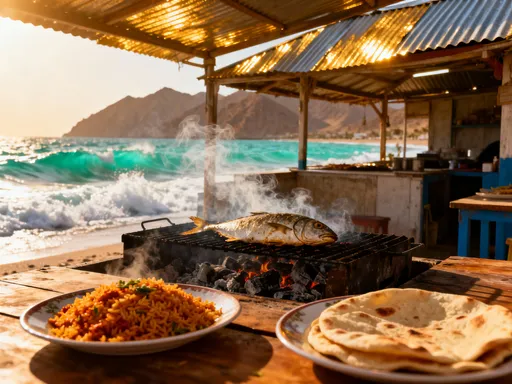
With over 120 kilometers of coastline along the Gulf of Oman, Fujairah’s relationship with the sea is central to its cuisine. Along Al Aqah Beach and the Corniche, small family-run seafood restaurants offer front-row seats to both the ocean and the day’s catch. These are not fancy dining rooms with white tablecloths, but open-air shacks with plastic chairs, checkered tablecloths, and grills that smoke from morning until night. The menu is simple: hammour, kingfish, shrimp, and lobster—whatever the fishermen pulled in at dawn.
Hammour, a type of grouper, is the star. Thick fillets are marinated in a light blend of salt, lemon, and black lime, then grilled over charcoal until the edges char slightly and the inside remains tender and flaky. The flavor is clean, briny, and deeply satisfying—no heavy sauces needed. Kingfish, with its firmer texture, is often served whole, head and all, a sign of freshness and respect for the animal. Shrimp are grilled in their shells, their sweetness intensified by the smoky char.
Dining here is an experience of the senses. The sound of waves blends with the sizzle of fish on the grill. The scent of salt and smoke fills the air. Children run barefoot near the water’s edge, while elders sit back, sipping lemonade and watching the sunset paint the sky in shades of pink and gold. Service is unhurried; dishes arrive when they’re ready, often carried by the owner or a family member. Bread comes warm, tomatoes are sliced fresh, and salads are made with local greens and cucumbers.
What makes this seafood so exceptional is its immediacy. Many restaurants have direct ties to local fishermen, some of whom still use traditional dhows and hand lines. The fish is often caught the same morning, sometimes just hours before it hits the grill. There’s no refrigerated supply chain, no long transport—just a short journey from boat to plate. This proximity ensures unmatched quality and supports sustainable fishing practices. It also means that menus change with the tides and seasons, offering only what is available and responsible to harvest.
For travelers, this kind of dining is a revelation. It’s not about luxury or presentation, but about authenticity and connection. Eating fresh fish with your hands, feet in the sand, the ocean breeze cooling your skin—this is food in its most honest form. It reminds us that the best meals are not always the most elaborate, but the ones that tie us to place, to people, and to the natural world.
Hidden Eats: Off-the-Beaten-Path Gems Only Locals Know
Beyond the souq and seaside shacks, some of Fujairah’s most memorable meals happen in places you’d easily miss. Tucked into quiet residential neighborhoods, behind unmarked doors or simple signage, are family-run eateries that serve food the way it’s made at home. These are not Instagrammable spaces with designer decor, but humble dining rooms where the focus is entirely on flavor, tradition, and hospitality.
One such spot, recommended by a local teacher, is a modest restaurant in a low-rise building near a mosque. Inside, the walls are plain, the tables are close together, and the air carries the rich aroma of spiced rice and slow-cooked meat. The specialty is machboos—a one-pot dish of basmati rice cooked with meat (usually chicken or lamb), onions, tomatoes, and a blend of spices including dried lime, saffron, and black pepper. The rice is firm, fragrant, and deeply colored, while the meat falls easily off the bone. It’s served with a side of daqqus, a fiery tomato and chili salsa that adds a bold kick.
Another hidden gem is a tiny bakery known only to those in the know. Located beside a school, it opens early and sells out by mid-morning. Its claim to fame is chebab, soft, spongy pancakes drizzled with date syrup or honey and sprinkled with sesame seeds. Watching them cook is a small joy—the batter poured into a hot skillet, bubbles forming on the surface, the edges crisping just enough before being folded and drenched in syrup. Locals buy them by the dozen, wrapping them in paper to take home for breakfast or afternoon tea.
These places thrive because they don’t try to impress. They exist to feed families, to preserve recipes, and to keep traditions alive. There’s no English menu, no online reservation system, no social media presence. You find them by word of mouth, by asking a shopkeeper, or by simply wandering and following the smell of spices. And when you do, you’re not treated like a customer—you’re treated like a guest. The owner might join your table, asking how you found the place, offering extra bread or a second cup of chai. In these moments, the boundary between traveler and local dissolves, and you taste something even more valuable than the food: belonging.
From Farm to Table: The Role of Local Agriculture in Fujairah’s Cuisine
Fujairah’s culinary identity is shaped not only by the sea but also by its fertile valleys and mountain farms. Nestled in the foothills of the Hajar Mountains, Wadi Wurayah is a protected ecosystem that supports agriculture in ways unseen in other parts of the UAE. Here, terraced farms grow citrus fruits, pomegranates, bananas, and dates, irrigated by ancient falaj systems—networks of channels that have carried mountain water to fields for centuries.
These farms are more than scenic; they are essential to the emirate’s food supply. Local restaurants proudly source their ingredients from nearby orchards, ensuring freshness and supporting sustainable practices. At a family-run citrus grove near Dibba, visitors can pick their own oranges and limes, tasting the difference that soil, altitude, and care make. The fruit is juicier, more aromatic, and less acidic than imported varieties. Farmers explain how the cool mountain air slows growth, allowing flavors to develop more fully.
Date farming is another cornerstone of Fujairah’s agricultural heritage. The emirate produces some of the finest dates in the country, with farms cultivating dozens of varieties. During harvest season, families work together to collect the fruit, clean it, and prepare it for sale or home use. Some dates are eaten fresh, others are dried or pressed into syrup. Local bakeries use date paste in sweets, while home cooks stir it into porridge or serve it alongside cheese and bread.
What’s remarkable is how these farming traditions are being preserved and even revived. With growing interest in sustainability and food security, Fujairah has invested in eco-friendly agriculture, promoting organic methods and water conservation. Schools organize field trips to farms, teaching children about where food comes from. Some farms now offer agritourism experiences—guests can tour the fields, participate in harvests, and enjoy meals made entirely from what’s grown on-site.
This farm-to-table ethos is not a trend here; it’s a way of life. Seasonal changes are reflected in menus: citrus in winter, figs in summer, dates year-round. There’s no reliance on imported produce when local alternatives exist. For travelers, visiting these farms adds depth to the culinary journey. It’s one thing to eat a dish, but quite another to see the soil it came from, meet the people who grew it, and understand the generations of knowledge behind it. In Fujairah, food is never disconnected from its source.
Why Fujairah’s Food Culture Matters—And Why You Should Experience It
Fujairah’s food culture matters because it offers something increasingly rare in the modern world: authenticity. In an era of fast dining, globalized menus, and culinary imitation, this emirate remains rooted in its own traditions, ingredients, and rhythms. Its cuisine is not designed for viral moments or Michelin stars. It exists to nourish, to connect, and to honor the past.
Every meal tells a story—of fishermen rising before dawn, of farmers tending ancient groves, of grandmothers stirring pots with practiced hands. The flavors are not exaggerated for effect but allowed to speak for themselves. There is pride in simplicity, dignity in tradition, and joy in sharing. Dining here is not a transaction; it’s an invitation into a way of life that values slowness, community, and respect for nature.
For travelers, especially those seeking more meaningful experiences, Fujairah offers a powerful alternative to the high-speed glamour of other Gulf cities. It asks you to slow down, to listen, to taste with curiosity and humility. It reminds you that the best food is not always the most expensive or elaborate, but the one made with care, shared with love, and rooted in place.
So if you’re planning your next trip, consider going beyond the expected. Seek out the quiet corners, the unmarked doors, the markets where locals shop. Let the scent of cardamom guide you, the sound of sizzling fish draw you in, the warmth of hospitality welcome you. In Fujairah, every bite is more than a meal—it’s a story waiting to be tasted. Come with an open heart, and leave with a fuller understanding of what it means to truly eat like you belong.